

What is Swiss Type turning?
Precision machining for complex parts.
The term “longitudinal turning” derives from the German Längsdrehung and refers to a turning process utilizing technology originally developed in Switzerland for the manufacture of watch components. In English terminology, this is commonly referred to as “Swiss-type” machining. Swiss-type lathes are specifically designed for the high-precision production of long, slender, small-scale, and complex parts. Although originally developed for the Swiss watchmaking industry, this technology has become a preferred solution for manufacturing complex components across various sectors, including automotive, medical, electronics, aerospace, and general mechanical engineering.
Unlike traditional lathes, Swiss-type machines perform material machining close to the guide bushing. This design minimizes vibration and material deflection during the machining process, ensuring exceptional precision even when producing long, slender parts.

How does Swiss-type turning work?
In a Swiss-type lathe, the bar stock moves through a guide bushing, while the cutting tools remain stationary or move independently around the workpiece. Because the material is supported directly at the point of cutting, machining forces are significantly lower, resulting in higher precision and superior surface quality. Thanks to multiple tool holders, Swiss-type machines can perform several machining operations simultaneously—including turning, milling, drilling, threading, and cross-drilling—producing complex parts in a single setup.
Key advantages of CNC Swiss-type turning
Exceptional precision – Swiss-type machining ensures outstanding dimensional accuracy and repeatability, making it ideal for parts with very tight tolerances.
Superior surface quality – the stable machining process yields a high-quality surface finish, often reducing the need for secondary operations such as grinding.
Higher productivity – multiple tools can operate simultaneously, significantly reducing cycle times and improving production efficiency.
Production of complex parts – Swiss-type machines can produce components with highly complex configurations in a single machining cycle. Cost-effective production – reduced setup times, lower material waste, and higher machining speeds make Swiss-type lathes suitable for medium- and high-volume orders.
What kind of parts can be produced using Swiss-type lathes?
Precision shafts and axles
Pins and fasteners
Connectors and fittings
Medical components
Various types of housings
Hydraulic and pneumatic parts
Automotive components
Aerospace and subsea equipment components
Electronic and electrical parts
Materials that can be machined
Swiss-type lathes are suitable for a wide range of materials, from commonly used carbon steels (e.g. 1.0718, S235, S355, C45, 42CrMo4 etc.) and stainless steels (e.g. 1.4305, 1.4301, 1.4404, 1.4571 etc.) to aluminum (e.g. AL 6082, AL 6060, AL 2011, AL 7075 etc.), brass (e.g. CuZn39Pb3 and other), copper alloys, and titanium. Also various engineering plastics, such as POM, Ertallye, PE1000, Nylatron, Teflon, PTFE, PC and other, can also be machined.

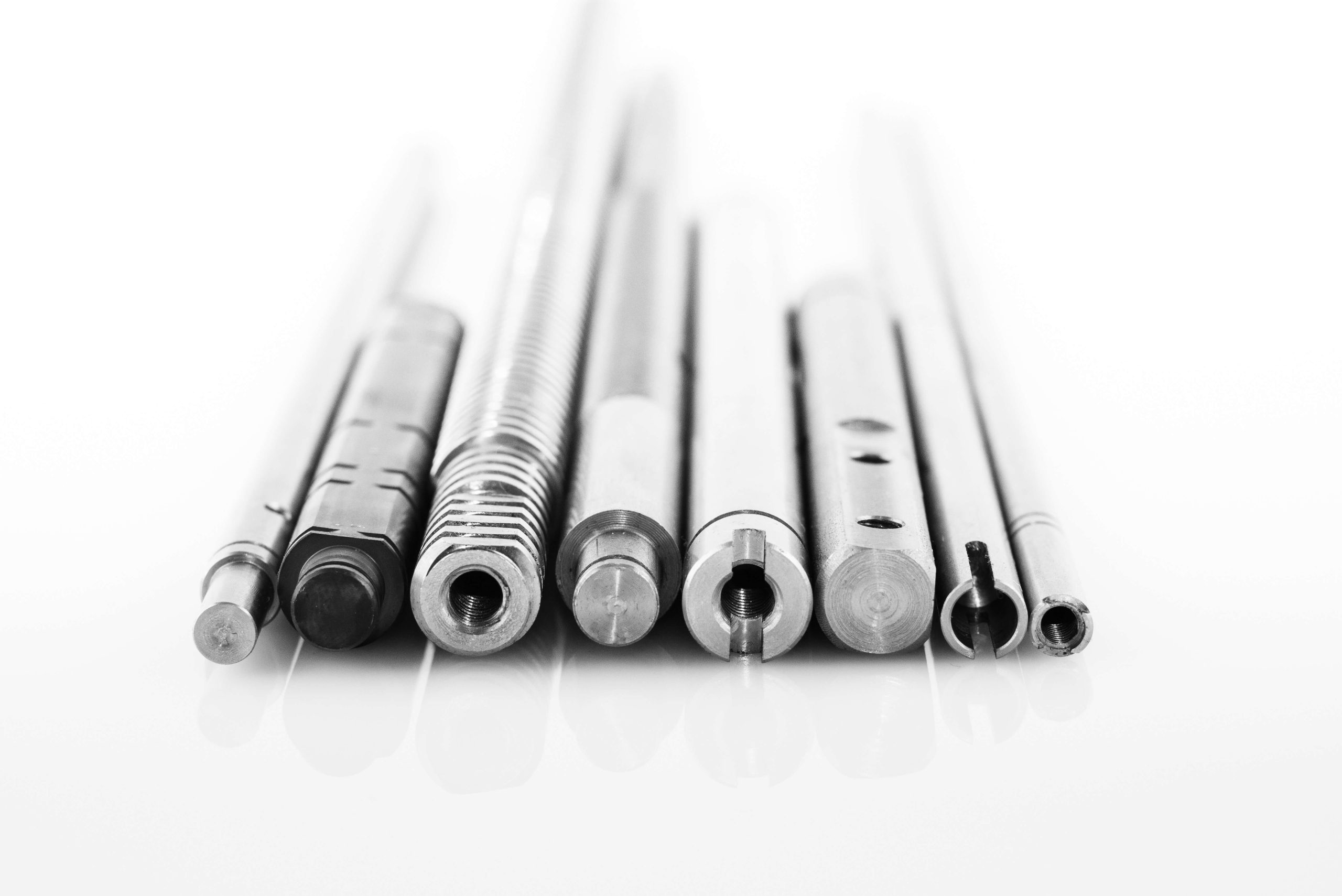

You can view more parts in our image galery here.
Why choose Baltma?
Baltma combines modern CNC technology with extensive manufacturing experience, ensuring precision and compliance with both client requirements and international standards. Our team’s expertise guarantees precision, superior quality, and reliability; whether you need prototype development, small-batch production, or large-scale manufacturing, we deliver precision parts tailored to your specific needs. Contact us to discuss your project and learn how CNC Swiss-type turning can enhance the quality, efficiency, and cost-effectiveness of your parts.


